Berried shrimp – from eggs to shrimplets
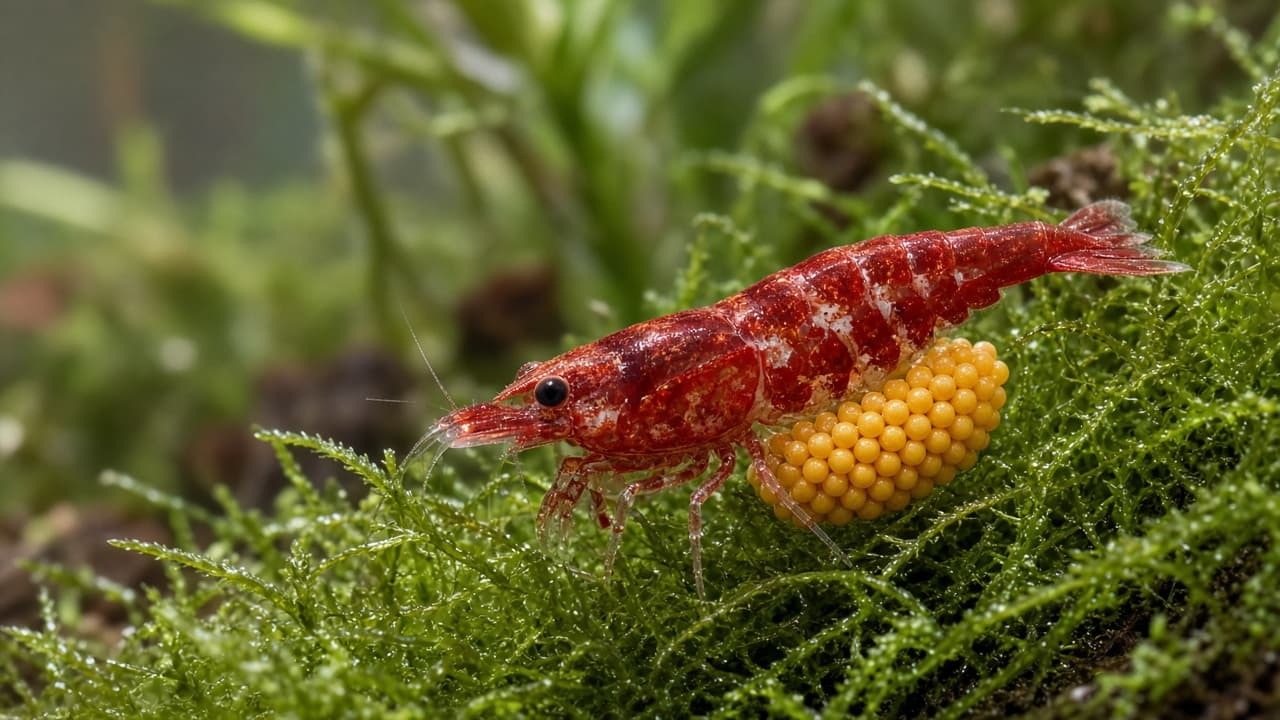
When a shrimp carries eggs under her tail, something important is happening in the tank. It is not only nice to look at. It is the start of the next generation.
Many people get nervous and want to do something extra. Most of the time it is better to let the female do the work and keep the tank stable.
How does a shrimp become berried?
The female moults. Right after the moult she releases pheromones. The males become active and search for her.
Mating is quick. After that she moves the fertilised eggs to the swimmerets under her tail. Then she is called berried.
What the eggs look like
The eggs sit as a small cluster under the tail. The colour varies. In Bloody Mary and Red Sakura they are often yellow, orange or red. In Crystal Red and Blue Bolt they can be more muted.
The female fans the eggs the whole time. That oxygenates them and keeps them clean.
If a few eggs drop off, that is common. It does not have to mean something is wrong.
How long does it take?
Most shrimp carry the eggs for about 3–4 weeks. Temperature affects the pace. Warmer water is usually a little faster. Cooler water is slower.
Towards the end you can sometimes see tiny eyes in the eggs. That is a good sign. Hatching is close.
Should you move the female?
In most cases, no. A move stresses her. Stress can make her drop the eggs.
Leave her in the tank where she already feels safe, as long as there are no fish that eat shrimplets and the filter cannot suck in tiny shrimp.
What she needs during this time
She needs the same things as usual. Stable water. Hiding places. Food in small amounts. Calm.
• Do not do large water changes
• Offer a little extra protein once a week
• Keep the temperature steady
• Leave mosses and plants in place
• Avoid poking at the female
When the shrimplets arrive
The shrimplets are mini versions of the adults. They do not need separate salt water or special larval food, unlike many fish.
They often sit in moss, on roots and along the glass. For the first days they are easy to miss.
What shrimplets eat
They eat biofilm, microorganisms and very fine food. A mature tank with moss is the best nursery.
You can crush ordinary shrimp food into a fine dust. Feed a little. Remove leftovers. Shrimplets do not tolerate dirty water.
When something goes wrong
The female drops the eggs
This happens with stress, poor water, or if the eggs were not fertilised. Once is not a crisis. If it happens often, look at water values and disturbances.
The eggs turn white or mouldy
Then the eggs are usually dead. The female may clean them away herself. Do not pick at them unless you must.
No shrimplets are visible after hatching
They may be hiding. They may also have been sucked into the filter or eaten by fish and larger invertebrates. Secure the filter and check the moss with a light.
What you should not do
Do not move her into a brand new tank in the middle of the berried period. Do not start large cleaning projects. Do not pour in harsh products. And do not overfeed to celebrate.
A berried shrimp is a sign that the tank already works. The job is not to disturb it.
Next step
Once you have seen the eggs hatch, the whole cycle is easier to understand. After that, shrimplet survival is what decides whether the colony truly grows.