What do Grade A, S, SS and SSS mean?
When you start looking at shrimp more closely, the words Grade A, S, SS and SSS appear everywhere. They sound like a fixed standard. They are not.
Grades are a language breeders use to describe colour, coverage and pattern. They help you sort, but they are not an official certificate.
Why grades exist
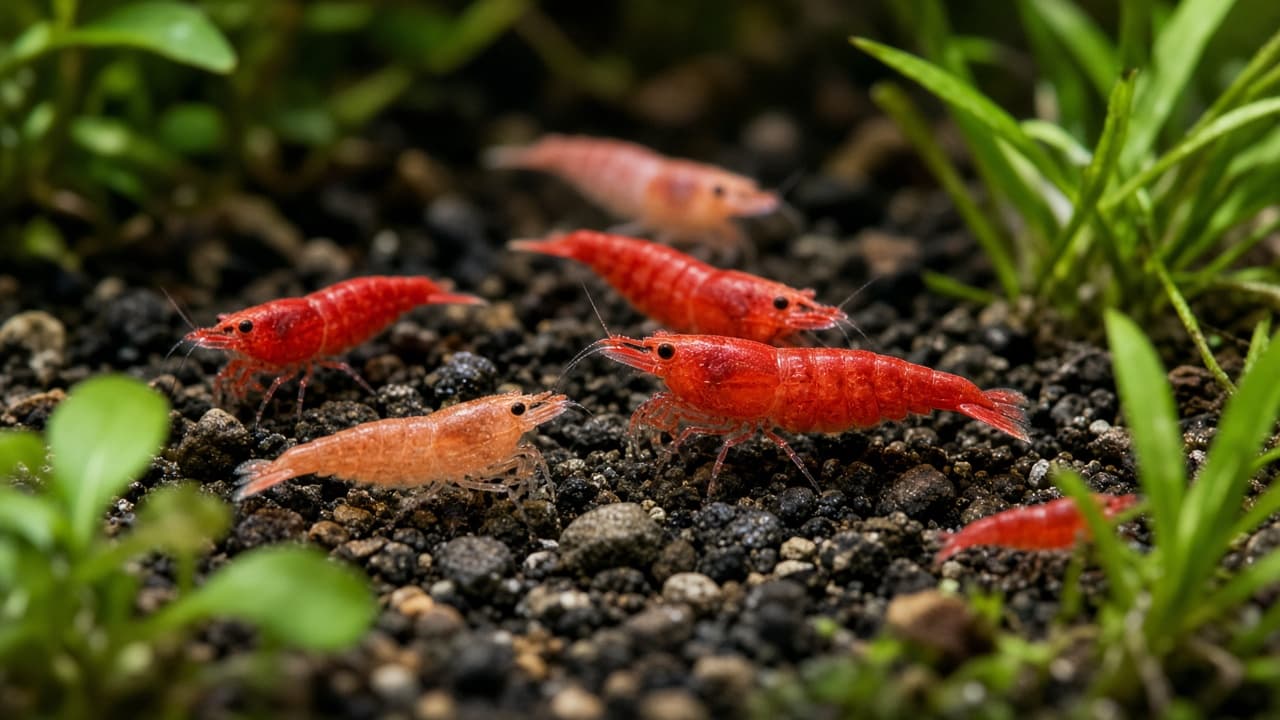
As a colony grows, the difference between individuals becomes clear. Some shrimp are pale. Others have strong colour. Some have a clean pattern. Others are patchy.
Grades put words to that difference. They are used when you sell, buy, or choose which shrimp should continue in the breeding group.
There is no global standard
The most important thing to understand is that Grade S from one breeder is not always the same as Grade S from another.
Different species are also judged differently. A Red Sakura is judged mostly on colour and coverage. A Crystal Red is judged more on pattern, contrast and clean lines.
Always use photos, not just the letter, when you compare shrimp.
Grade A
Grade A is often the lowest saleable quality in a coloured line. The shrimp has colour, but the coverage is uneven. Legs, belly or neck may still be translucent.
In Crystal Red and Crystal Black, Grade A can mean the pattern is there, but broken, unclear or low in contrast.
Grade A is perfectly fine if you want a living colony. It is rarely the right choice if the goal is to lift a line quickly.
Grade S
Grade S is a step up. The colour is clearer. Coverage is better. In Neocaridina such as Bloody Mary, Red Sakura and Blue Diamond, this often shows as a more even body and less translucency.
In Caridina it shows as cleaner bands and better contrast between white and red or black.
Many colonies are built best with a mix of S animals and a few higher ones, not only top animals.
Grade SS
Grade SS is a clearly fine shrimp. The colour is strong. Coverage is high. The pattern sits more in place.
This is where the difference from S usually becomes visible even to an untrained eye. The shrimp looks more finished. It has fewer pale fields and fewer broken lines.
SS animals are common breeders when you want to lift a line without chasing extremely expensive top animals at once.
Grade SSS
Grade SSS is used for the best animals in a line. The colour is intense. Coverage is almost complete. In Caridina the pattern is clean, tight and high-contrast.
SSS does not mean the shrimp is perfect. It means the breeder judges it as the top of that colony, at that moment.
An SSS from a weak line can be worse than an SS from a strong line. Look at parents and siblings, not only at a letter.
Other labels you may see
Some breeders use more steps. You may see High Grade, Painted, Solid, Extreme, or species-specific names such as Hinomaru and Mosura in Crystal Red.
Those words often describe pattern type more than a number on a scale. Learn what the seller means before you compare prices.
How to use grades in practice
Use grades as a rough filter. Not as the truth.
• Buy from photos and video, not only from a letter
• Compare several animals from the same clutch
• Keep the same line together
• Keep the best females and males for breeding
• Sell or move down animals that do not carry the line forward
Common mistakes
Thinking SSS always produces SSS shrimplets
Shrimplets inherit the line, not only the look of one parent. A beautiful shrimp from a mixed colony can give very mixed results.
Mixing different lines to get a higher grade
If you mix Bloody Mary, Red Sakura and wild-coloured animals, the next generation often gets worse, not better.
Paying for the letter without seeing the animal
Always ask for current photos. Shrimp change colour after moulting, stress and lighting.
What should you choose?
If you only want a beautiful colony, A and S are often enough. If you want to breed more deliberately, SS is a good base. SSS is most useful when you already have control of water, food and sorting.
The next step is to learn how to sort a whole group, rather than chasing a single top shrimp.