Breeding and berried shrimp
When a colony is thriving, females start carrying eggs. It is one of the clearest signs that the aquarium is working.
Breeding in Neocaridina and most Caridina happens in freshwater. You do not need to move females, change the temperature, or hunt for a particular male. If the water is stable, food is available and the shrimp are well, nature often takes over.
This guide covers how to recognise a berried shrimp, what happens during the weeks she carries the eggs, and what you can actually do to help.
When shrimp start to breed
A healthy Bloody Mary or Red Sakura colony can produce the first berried female within a few weeks in a mature tank. That does not mean everything is perfect. It means the female feels safe enough to invest energy in eggs.
Amano shrimp are the exception. They do not complete the same freshwater breeding cycle, so an Amano female with eggs in a home tank rarely leads to shrimplets. For the shrimp most people keep – Neocaridina and Crystal types – breeding is entirely natural.
How to recognise a berried shrimp
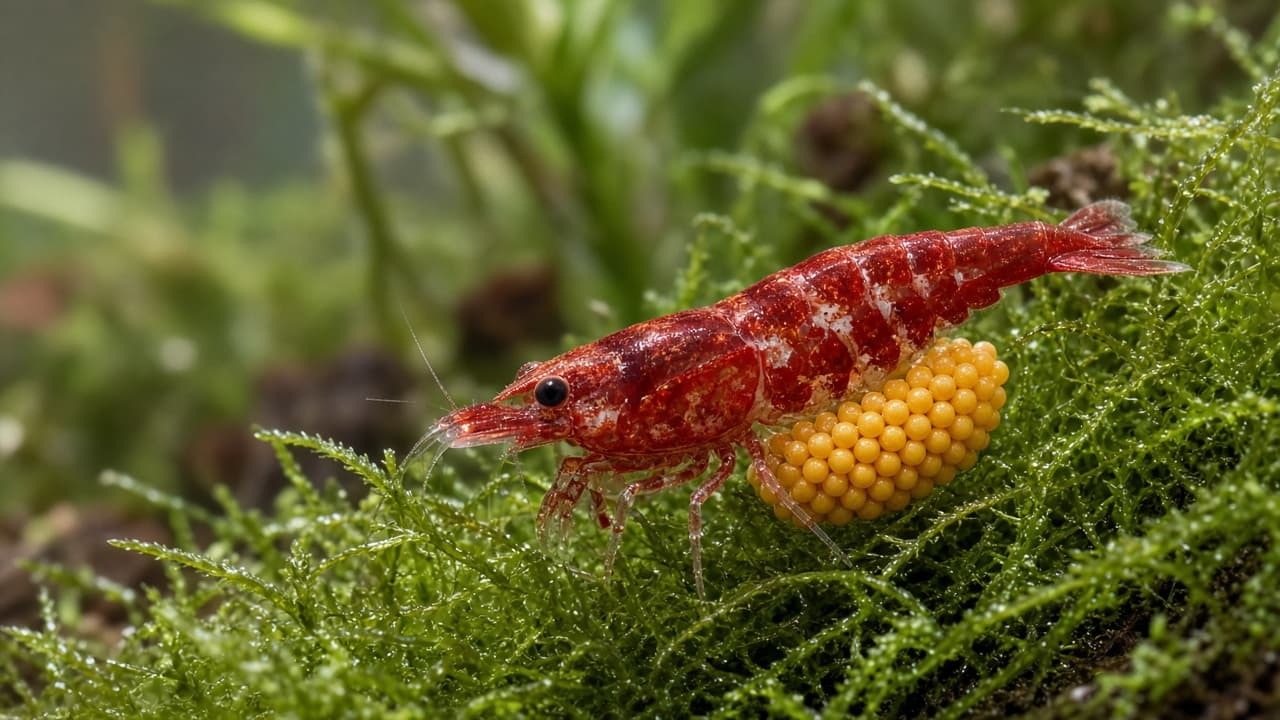
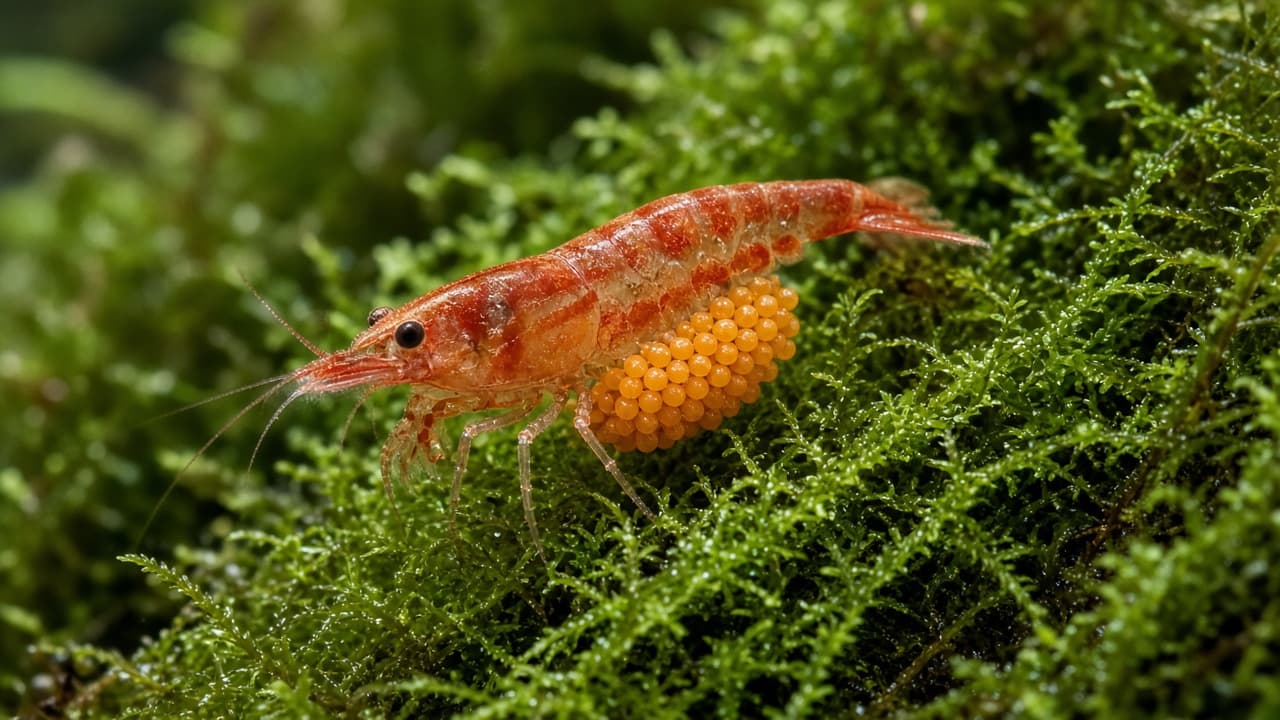
A berried female carries a tight cluster of eggs under the abdomen, protected by her swimmerets. The eggs are easy to see from the side.
• Yellow or orange eggs in many Neocaridina
• Darker or greenish eggs in some Caridina
• The female fans the eggs regularly
• She often moves more carefully than usual
On a dark shrimp such as Blue Diamond, the eggs can be harder to see against the body. Look from below or against the light.
Saddle and eggs
Many people mix up two different stages. Both are good signs, but they do not mean the same thing.
The saddle
The saddle is a pale or yellowish triangle on the back, behind the head. Eggs mature there before they are fertilised and moved under the abdomen. A female with a saddle is ready to mate after her next moult.
Eggs under the abdomen
When the eggs sit under the tail, the female is berried. They are already fertilised. From here, the main job is to leave her alone and keep the water stable.
How long she carries the eggs
Most dwarf shrimp carry eggs for about three to four weeks. Warmer water shortens the time a little. Cooler water lengthens it.
Towards the end the eggs often darken. Sometimes tiny eye spots appear. That is a good sign that hatching is close.
What the female does in the meantime
She oxygenates the eggs by fanning them with her swimmerets. She also cleans them. If an egg moulds or dies, she often drops it. That is normal and nothing you need to pick out.
Should you move the berried shrimp?
In most cases, no. A move stresses the female. Stressed females sometimes drop the whole clutch. An established tank with moss, wood and biofilm is usually the best nursery.
Move her only if the tank has fish that eat shrimplets, an unsafe filter intake, or if you already have a separate breeding tank that is mature and shares the same water values.
When the shrimplets hatch
The young are miniature adults. They do not school in open water. They usually sit in moss, on leaves and along the glass. In the first days they are easy to miss.
• Check the moss in the morning
• Look along the front glass
• Avoid heavy substrate cleaning in the first weeks
• Do not feed more just because shrimplets have arrived
The female does not care for the young after hatching. The colony does it by leaving biofilm, hiding places and calm water.
Common misunderstandings
• That the female must be isolated for the young to survive
• That you must raise the temperature to force breeding
• That a female who drops eggs is ill
• That Amano shrimp produce shrimplets in ordinary freshwater
A female may drop eggs after a move, a large water change or a poor moult. It is disappointing, but she can carry a new clutch later.
What you can do to help
You influence breeding most through the environment, not by handling the female.
• Keep the water stable
• Make sure the filter is shrimp-safe
• Provide plenty of moss and fine-leaved plants
• Feed little, but regularly
• Leave leaves and biofilm in place
Conclusion
A berried shrimp is proof that the colony is doing well. Let her carry the eggs in the tank where she already feels at home, and make that tank safe for the young that follow.
Once you have seen your first clutch, the next step is to understand why some shrimplets disappear – and how you give more of them a chance to grow up.