Breeding tanks and multiple setups
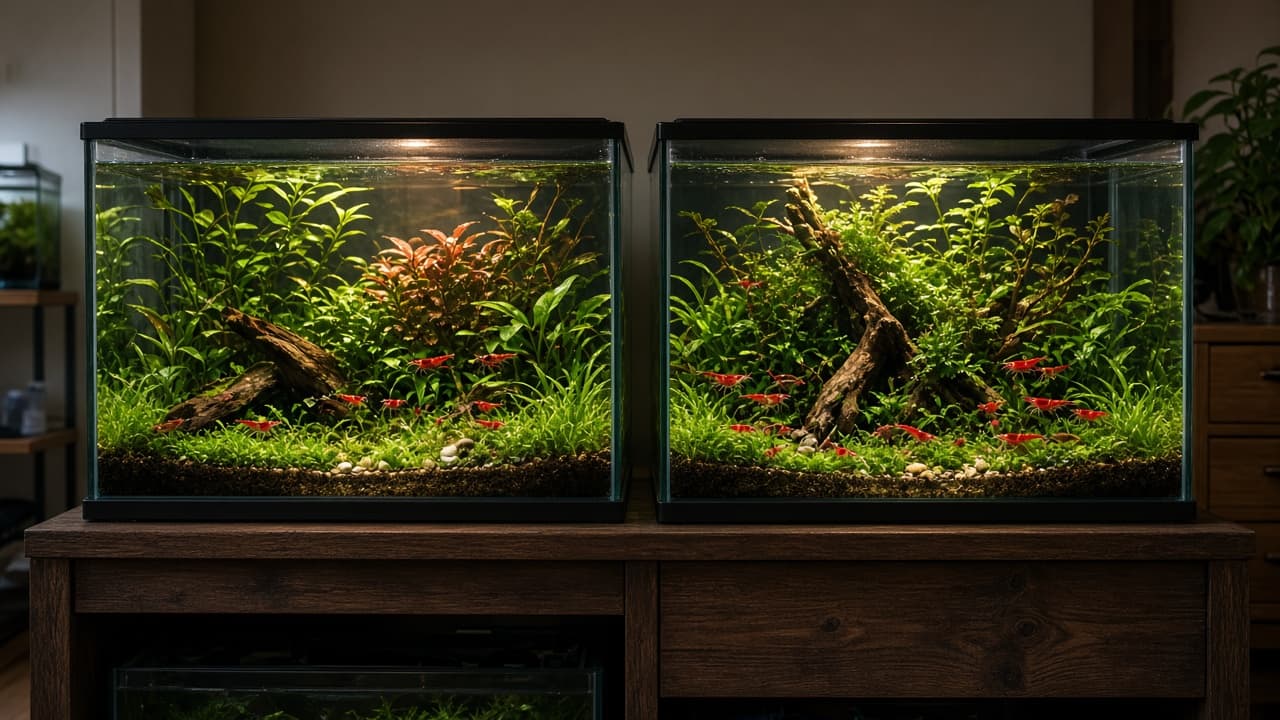
One aquarium can be both beautiful and produce young. Once you start sorting, it is rarely enough on its own.
Several tanks let you keep colours apart, protect shrimplets and have one tank that looks the way you want. It does not have to become a room full of racks.
This article is about when it is worth expanding, and how to do it without letting the chore list grow faster than the colony.
When one tank is not enough
One tank is enough as long as you keep one variety, accept mixed quality and do not have fish that eat shrimplets.
You need more when you want Blue Diamond and Red Sakura at the same time, when you need to remove weaker animals, or when the display tank has too much flow and too little moss.
What a breeding tank is
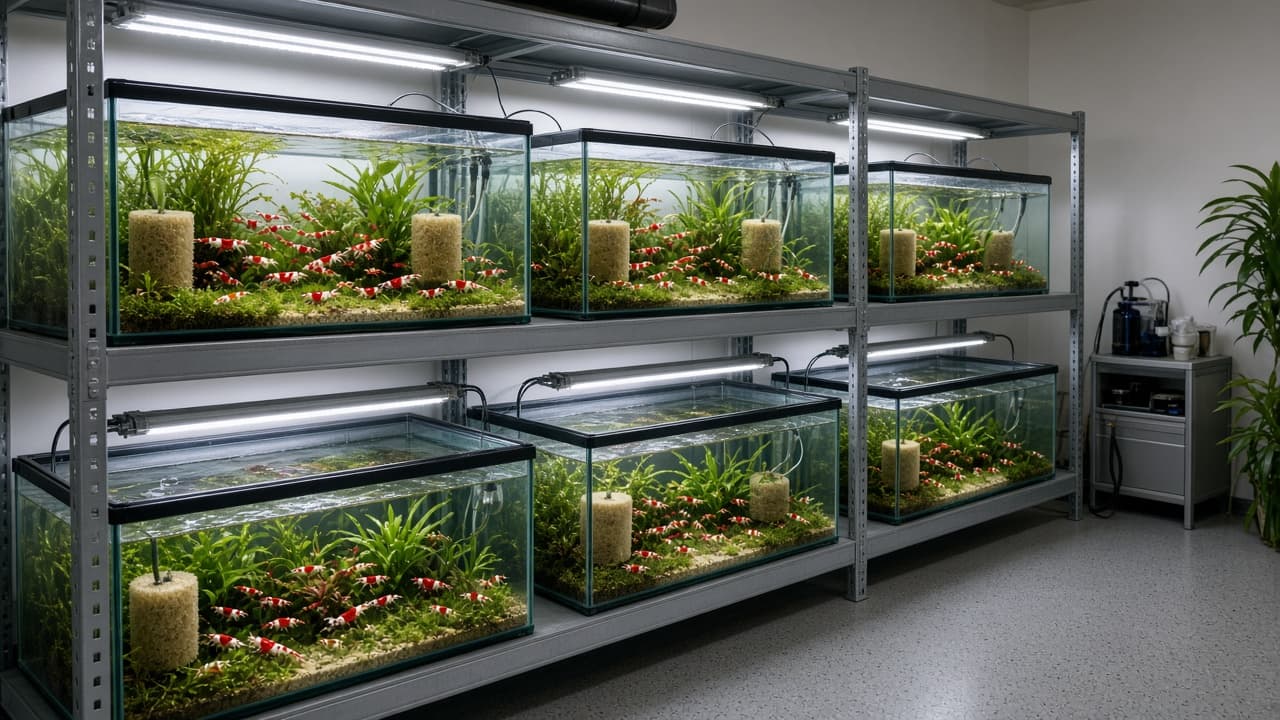
A breeding tank is furnished for shrimp, not for visitors. Plenty of moss, a shrimp-safe filter, calm lighting and easy access beat a hardscape.
It can be 20–40 litres. Smaller than that swings faster. Larger is fine if you can still reach in to look and sort.
Display and breeding
The display tank is the one you watch. The breeding tank is the one you work in. Many people keep the best-looking animals out front and the breeding group in a simpler tank behind or below.
Amano shrimp often do best in the display tank. They clean well and do not breed in freshwater, so they do not disturb a colour line.
How many tanks you actually need
Two tanks is a big step. One for breeding, one for culled animals or a second colour. Three tanks is enough for most home keepers for a long time.
• Tank 1: the breeding line
• Tank 2: culled animals or display
• Tank 3: the next colour or quarantine
More than that is possible, but then water changes and feeding become a schedule. Do not expand until the tanks you have are stable.
Same water, different jobs
If the tanks stand in the same room and are filled with the same mix, moves become easier. Crystal Red going from a soil tank into tap water in the display will have a hard time.
Try to keep the same type of water in tanks that will exchange animals. That reduces stress more than any decoration you choose.
Practical points
• The same temperature as far as possible
• The same minerals if you use RO
• Separate nets per tank if you have had disease
• Label tanks with colour and start date
Moving between tanks
Acclimatise even between two tanks in the same home. The difference can be larger than you think, especially if one tank has active soil and the other has sand.
Move a few shrimp at a time rather than the whole colony in one evening.
Equipment you can reuse
You do not need a new cabinet for every tank. The same bucket, hose and test kit will do. Each tank should have its own filter, though. Do not move an uncleaned sponge between a sick group and a healthy one.
Time and maintenance
Two tanks do not take twice as long if they are simple. They take more time if both are densely scaped and chased toward perfect values.
Keep breeding tanks simple. Spend the time looking at the shrimp, not polishing every stone.
A realistic first step
Do not buy three tanks on the same day. Set up a second tank, cycle it, and then move either culled animals or a new line.
When the second tank has biofilm and stable values, you have a real breeding system, not just more glass.
Conclusion
Several tanks are a tool. They let you keep lines clean and shrimplets safe, without forcing the display tank to do everything.
Before you fill the shelf, also learn when shrimp should actually be moved, and when they are better left where they are.