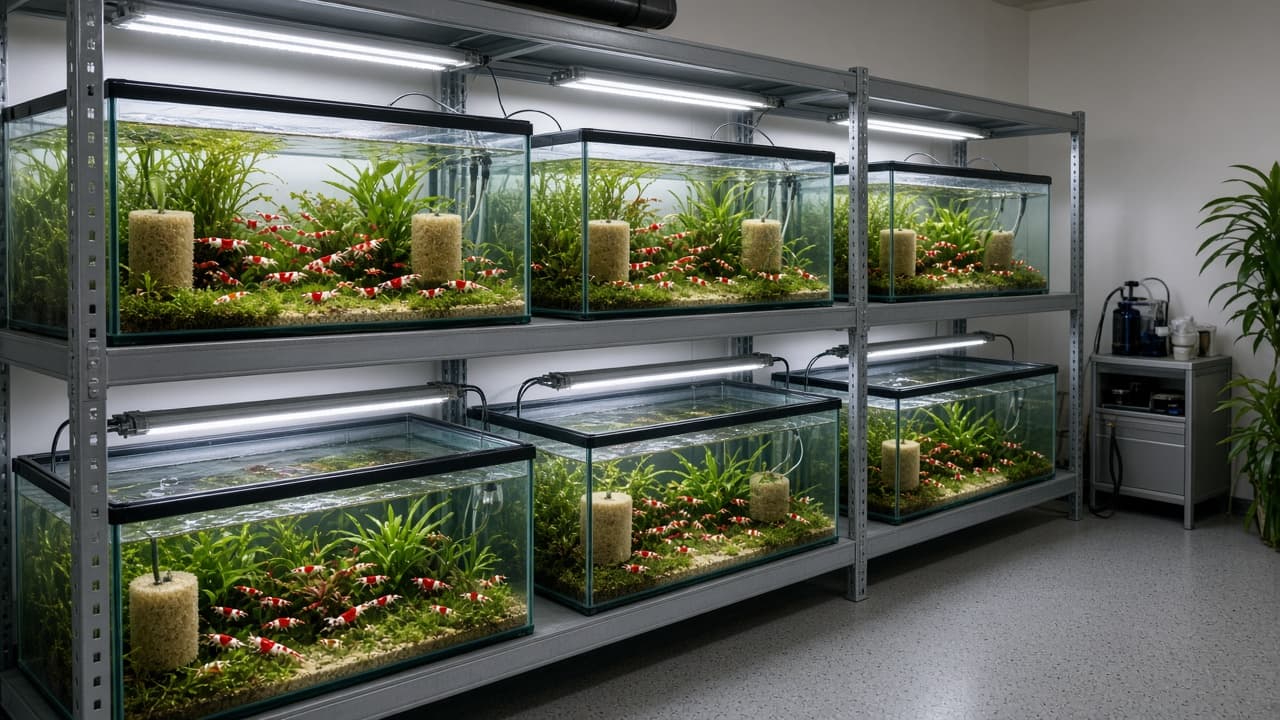
Documentation and Breeding Logs

A breeding log is not bureaucracy. It is the only way to see what actually worked.
Without notes, Crystal Red, Blue Bolt and Red Sakura become a feeling in the back of your mind. With notes, they become a line you can steer.
Why the log is the breeding tool
You will not remember the TDS from March. You will not remember which male gave the even brood.
The log remembers. That is why experienced breeders look calm. They guess less.
What to record every week
• TDS, pH, temperature
• GH and KH when you measure them
• Water change in litres and recipe
• Deaths, molts and visible berried females
Five lines beat an essay. It has to be fast enough that you actually do it.
Water values and events
Write what you did, not only the number. "Changed 15 percent, same recipe" says more than "TDS 118" alone.
Also note filter changes, new soil and new food. That is often where a dip starts.
Lineage and tank IDs
Give every tank a name or number. Write which line lives there, for example Crystal Black A or Bloody Mary 2025.
When you move animals, write from which tank to which. Otherwise the outcross disappears into clutter.
A minimum per line
• Start date and origin
• Latest outcross
• A goal for the next two generations
Photos as a complement
Use the same angle and the same lamp. Once a month is enough to see whether Red Sakura is actually getting more even.
Also save a photo of a typical unsorted juvenile. That picture tells the truth about the line.
How you use the data
Look backwards when something goes wrong. If pH started rising three weeks before the broods died, you have a hypothesis.
Look backwards when something goes well too. Otherwise you cannot repeat it.
A simple template
Date. Tank. Values. Change. Animals. Decision. One line is enough. A table in a notebook or a simple spreadsheet is more than enough.
Do not build a system so heavy that you stop writing.
Digital or paper
Paper sits by the tanks. The phone sits in your pocket. Choose what you open when your hands are wet.
Back up the digital copy. A drowned notebook can be rewritten. A deleted folder with two years of Blue Bolt data cannot.
Common pitfalls
• Writing only when things go badly
• Changing the template every month
• Recording colour words without saving a photo
• Letting the log become a diary without decisions
Make the log a habit
Tie it to the water change. Measure, change, write. Then it is there later when you select or sell.
When the log is alive you have a base for everything else at advanced level. Keep reading at AquaShrimp and let the next note be clearer than this week's.