Feeding shrimp – how often and how much
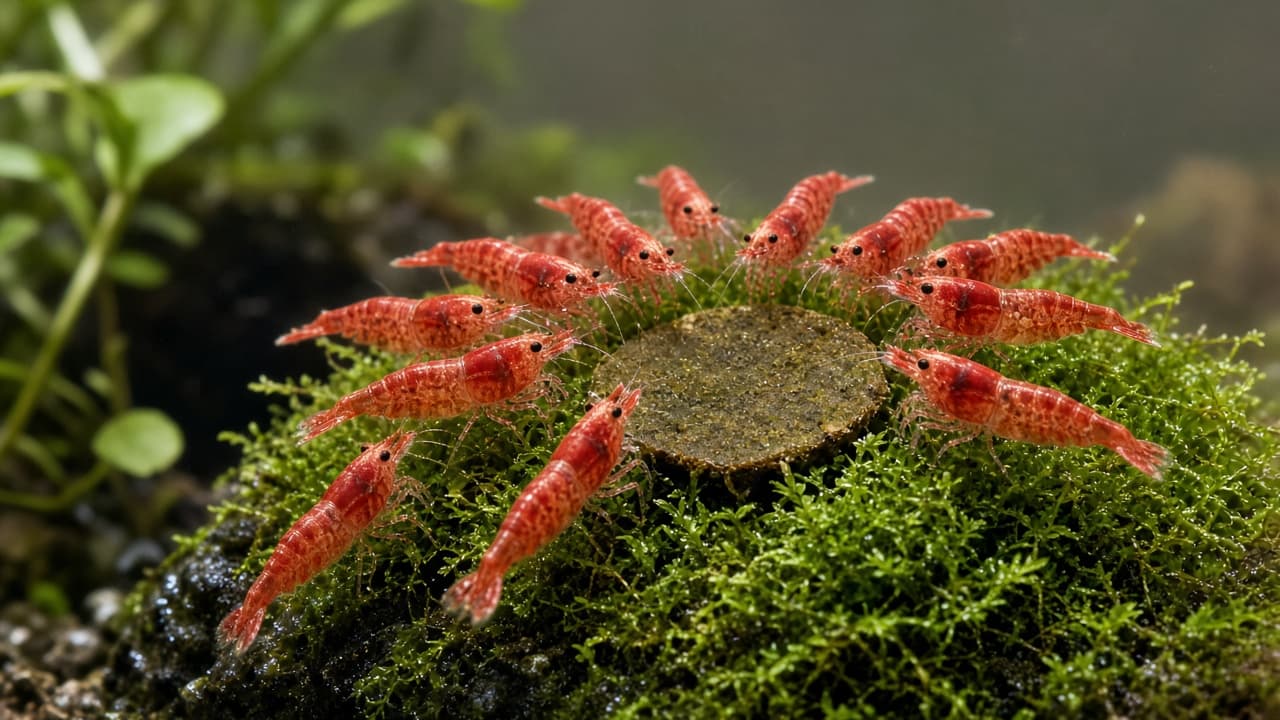
Shrimp are constant grazers. They move around the aquarium picking at small bits all day, even when you are not adding food.
That is why many beginners feed too much. The shrimp look hungry, but they usually already have food on leaves, roots and glass.
How shrimp eat in the aquarium
Neocaridina such as Bloody Mary, Blue Diamond and Orange Sakura graze biofilm, soft algae and tiny particles. Amano do the same, but they often eat more visible algae than dwarf shrimp.
The food you drop in is a supplement. It is not the whole diet, except in a brand-new tank where the biofilm has not yet built up.
How often should you feed?
In a mature, planted aquarium, 2–3 times a week is often enough. Some tanks with plenty of moss and an established colony can go even less often.
In a young tank you can feed a little more often, but in small amounts. The goal is for the shrimp to find food, not for the substrate to be covered in it.
How much is enough?
Add so little that it is gone within two to three hours. A small piece of food for ten Red Sakura is often more than enough.
If you still see food the next day, you have given too much. Remove the leftovers. It is better for the shrimp to search a little extra than for the water to turn dirty.
Which food suits beginners?
A complete shrimp food in tablet or granule form is the simplest base. It should sink and hold together, so the shrimp can graze without clouding the water.
• Complete shrimp food a few times a week
• Boiled or blanched vegetables now and then, such as courgette or spinach
• Dried leaves such as catappa or oak as extra grazing surface
• Not fish food as the main diet
Biofilm is the best food
Shrimplets of Yellow or Blue Navy rarely survive on pellets alone. They need the thin film that grows on plants and décor.
That is why a mature aquarium with moss is so forgiving. It feeds the colony even on the days you do nothing at all.
Overfeeding is the most common mistake
Too much food means more waste, more nitrate and more algae. Snails often appear at the same time, not because they are enemies but because there is a surplus.
A colony that looks less active after feeding is not necessarily hungry. They may be full, or the water may already be loaded.
Fasting days
One or two days without extra food each week is useful in most tanks. The shrimp keep grazing, and the filter gets a chance to catch up.
Feeding in a new aquarium
When shrimp have just moved in there is often little natural food. Then you can give a very small pinch every day at first, but only for as long as it is all eaten.
Do not increase the amount just because you bought more shrimp. Ten extra Crystal Red or Bloody Mary does not mean you should double the food overnight.
Different shrimp, slightly different appetite
Amano eat more algae and may need extra protein now and then. Crystal Red and Blue Bolt are often more restrained and handle overfeeding worse, because their water is already more sensitive.
Neocaridina are generally more forgiving, but the same rule applies: too little extra food is better than too much.
A simple feeding routine
Pick three fixed days. Give a small piece. Check after three hours. If food remains, give less next time. If nothing is left and the shrimp look lively, you have hit the right amount.
When feeding stays light, both algae and water values become easier to understand. That is a good base before you look at how many shrimp the tank can actually support.