Line Breeding and Outcrossing
Line breeding locks in what you like. Outcrossing gives back the vigor that closed breeding takes.
In Crystal Red and Crystal Black this is the usual way of working. You breed within the line until the pattern holds, and open it when the brood loses pace.
What line breeding means
You pair animals that already share origin and goal. Not necessarily siblings every time, but the same strain.
The goal is predictability. A Red Sakura line should produce Red Sakura, not a lottery.
When you keep the line closed
Keep it closed as long as broods are large, shells are sound and the pattern is getting clearer. Then closed breeding is doing the work.
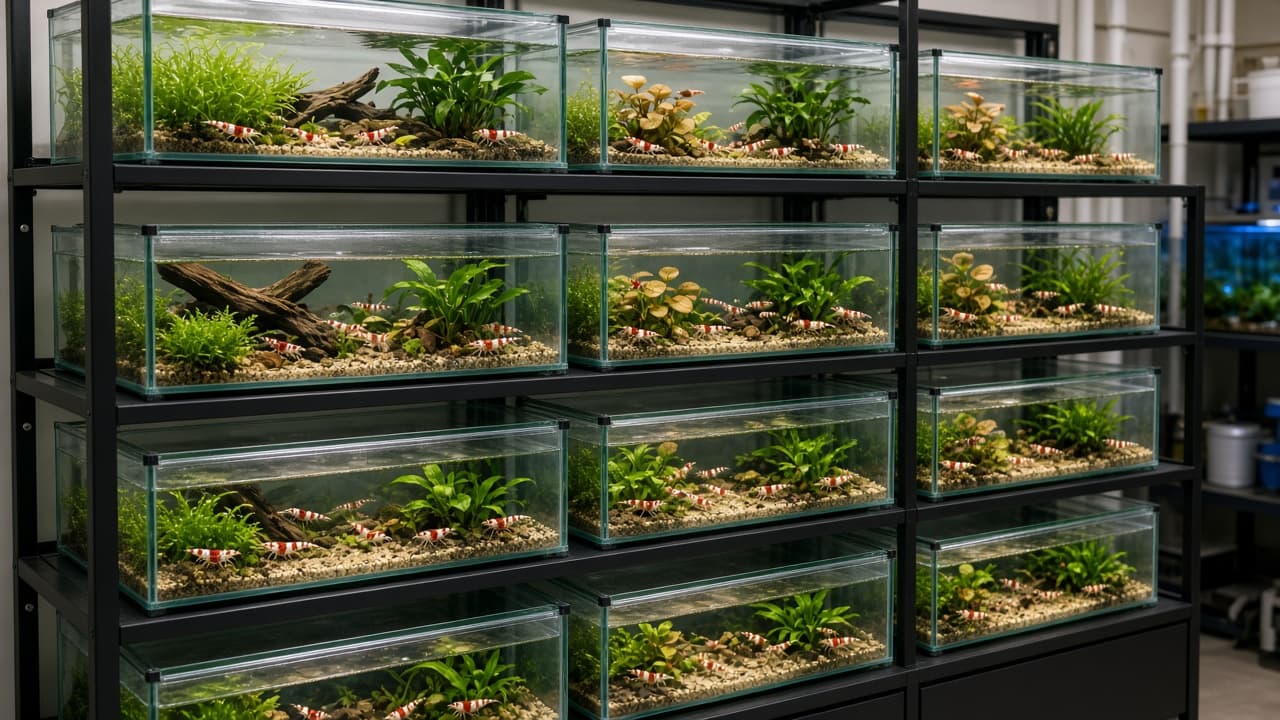
Record which tanks are sibling tanks. Otherwise you "outcross" without knowing they are already cousins.
When you must outcross
Fewer eggs, more dead shrimplets and shrimp that do not grow are clearer signals than slightly paler colour.
Do not wait until the line is so weak that you have to rescue it with anything.
Choose an outcross partner
Take the same variety from another strain. An unrelated Crystal Red beats a pretty Blue Bolt if the goal is to save a bee line.
If you deliberately cross Crystal Red with Crystal Black, do it in a project tank. Do not mix it into the main line until you have seen F2.
Questions before you buy in
• Do they come from the same origin as your line?
• Have they carried young recently?
• Is the water close enough for a calm start?
F1, F2 and what you look for
F1 is often vigorous and a little scattered in pattern. Do not judge it too hard. Judge the health.
F2 is where the line shows itself. There you see whether the outcross gave both life and the trait you wanted to keep.
Breed back to the line
When you find F2 animals that resemble your strain, pair them back to your best remaining stock. That is breeding back.
Do it in steps. One hard backcross can remove the vigor you just bought.
Record every cross
Write the date, which animals, which tank and why. A year later you only remember that it got worse for a while.
Photos of typical young from each generation are worth more than a long opinion in your head.
Common mistakes
• Outcrossing too early because you are impatient
• Outcrossing too late when the line is already fragile
• Releasing F1 straight among the best breeders
A workflow you can follow
Select for three generations, judge vigor, outcross on purpose, read F2, breed back. Then again.
When the rhythm is in place, move on to pH in soil tanks and breeding logs. Stay with AquaShrimp and let the line become clearer, not only narrower.