Temperature for shrimp
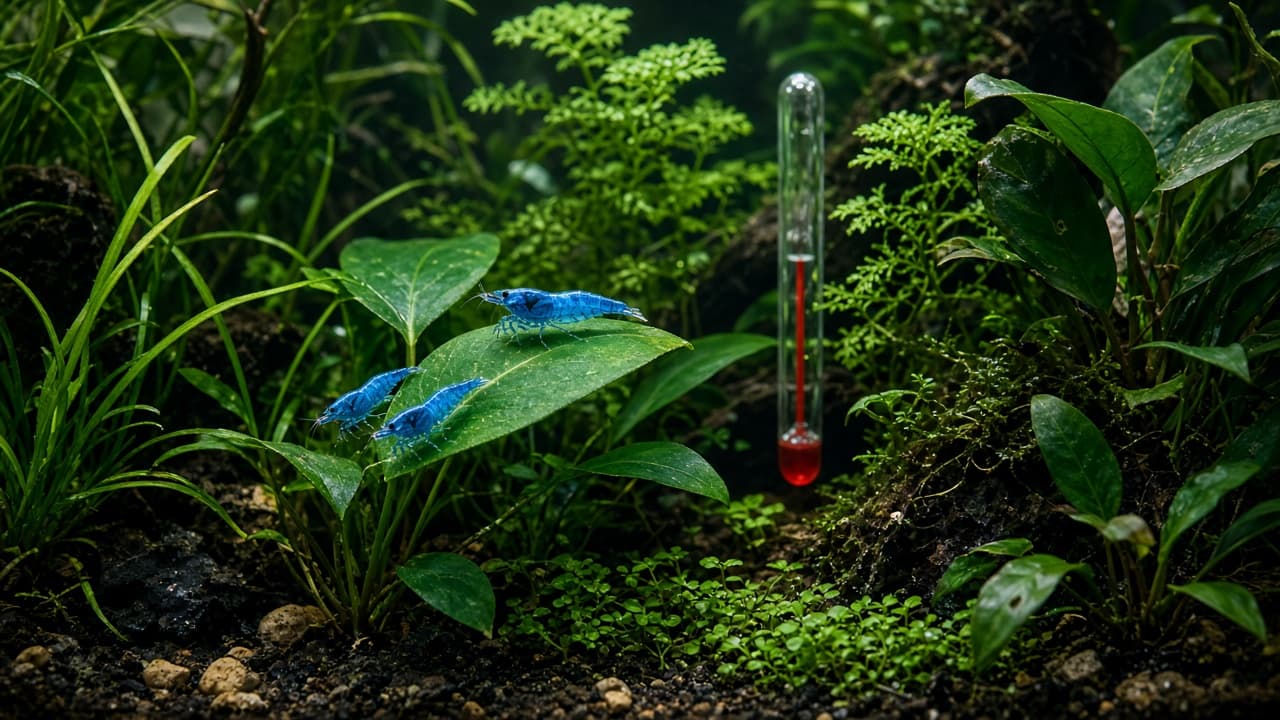
Shrimp can handle a fairly wide temperature range, but they dislike sudden swings. An even room is usually more important than an exact degree on the thermometer.
Many beginner tanks need no heater at all, as long as the room does not go cold at night or bake beside a window.
Which range works?
Neocaridina such as Bloody Mary, Red Sakura, Yellow and Blue Navy usually accept 18–28 °C. They typically do best somewhere in the middle, around 20–24 °C.
Crystal Red, Crystal Black and Blue Bolt are best kept a little cooler and steadier, often around 20–23 °C. They handle heat less well over time.
Stability matters more than warmth
A colony that lives at 21 °C all the time does better than a colony that swings between 19 and 26 depending on the weather and the radiator.
It is the jump that causes stress, not the thermometer showing one degree more or less than a chart.
Do you need a heater?
If the room sits steadily around 20–22 °C, most Neocaridina manage without a heater. A heater is useful if the night temperature drops clearly.
Choose a small, reliable heater and a thermometer you actually look at. A heater stuck on too high is more dangerous than no heater at all.
Summer heat
Above 26 °C the water holds less oxygen and the shrimp become more stressed. Lifespan shortens, and disease spreads more easily.
Keep the tank out of the sun. Cool the room if you can. An air stone can help oxygenation for a while, but it does not replace cooler water.
What not to do in a heatwave
Do not pour in cold water to shock the temperature down. Lower it slowly, and feed less while it is hot.
Winter cold
Below 18 °C Neocaridina become slower. They can survive, but they eat less and rarely breed. Below 16 °C the risk rises clearly.
Amano tolerate cold better than many dwarf shrimp, but a cold room over the holidays is still an unnecessary risk for the whole tank.
Temperature and oxygen
Warm water holds less oxygen. In a dense tank with many Orange Sakura this can show as shrimp gathering at the surface or sitting still.
Good surface movement from the filter helps. Do not seal the aquarium with a tight lid and no ventilation when it is hot.
Temperature and breeding
In the upper part of the range, metabolism runs faster. The shrimp may produce more broods, but they often live shorter lives.
In the lower, even part, growth is slower and the colony is often more sustainable. For most beginners that is a better goal than maximum breeding.
How to measure correctly
Measure in the water, not against the glass in the sun. A simple thermometer on the inside is enough. Check both morning and evening once in a while, so you see if the night differs.
• Avoid sunny windowsills
• Avoid a spot above a radiator
• Avoid draughty floors by balcony doors
• Let the room lead, not the weather outside the pane
A simple routine
Choose a shady, even spot. Keep 20–24 °C for Neocaridina if you can. Adjust the room before the tank. Never change in water that is clearly warmer or colder than the aquarium.
When the temperature is boringly even, it becomes easier to see the effect of feeding and water changes. Then you are ready for the practical how: when the change should be done and how it is done.