Water changes and water quality
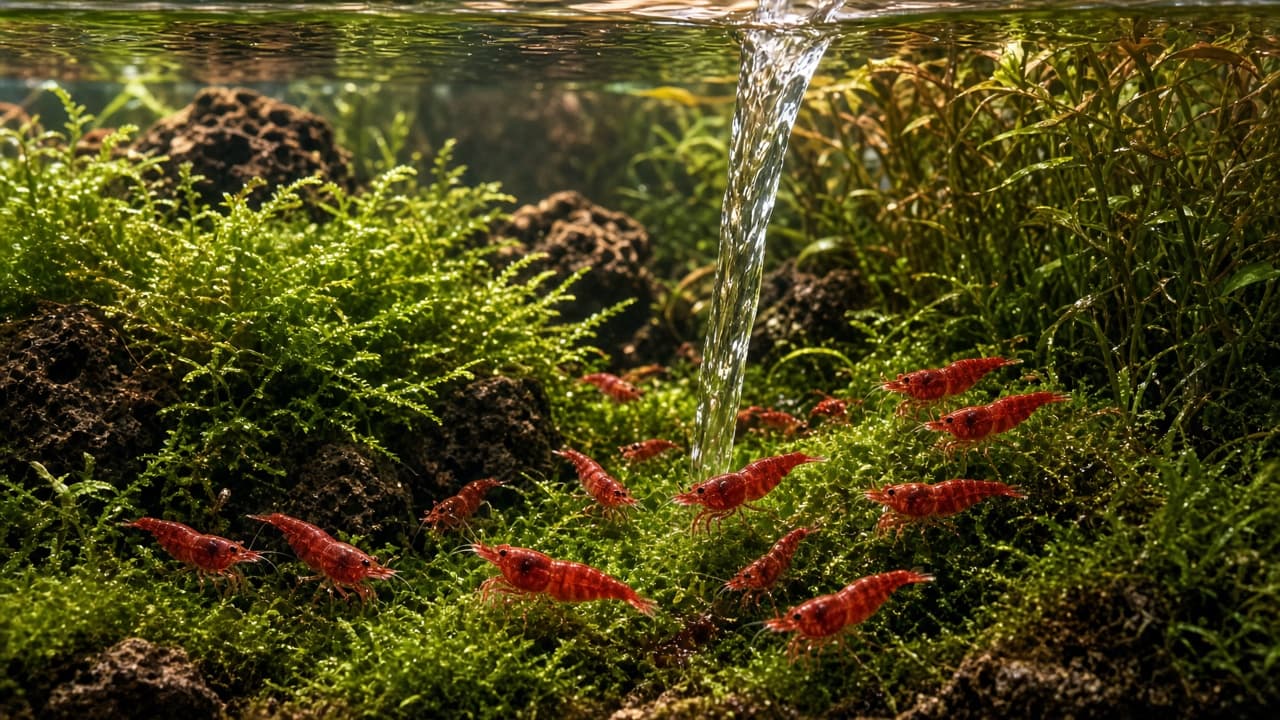
Good water quality is what keeps shrimp healthy over time. Water changes are one of the simplest ways to remove what builds up, without disturbing the whole aquarium.
It is not about changing as much water as possible. It is about keeping the water predictable.
What water quality means for shrimp
For shrimp, the water is both home and air. Everything released from food, waste and decaying plant matter stays in the same small volume until something deals with it.
A filter and plants do much of the work. The water change removes what otherwise slowly collects, such as nitrate and dissolved organic matter.
Ammonia, nitrite and nitrate
In a mature aquarium, ammonia and nitrite should be zero. Nitrate may be present, but it should not race upwards. Shrimp are more sensitive to poor water chemistry than many fish.
If you feed Red Sakura or Yellow every day and rarely change water, the load rises. That often shows first as cloudy water, more algae and shrimp sitting still.
Why shrimp react faster
Shrimp take up substances through both gills and body surface. A small change a fish barely notices can be enough to stress a Bloody Mary.
Amano usually tolerate a little more, but Neocaridina shrimplets are especially sensitive. Even water quality therefore matters more than one big clean-up.
What a water change actually does
A water change dilutes what has collected. At the same time it replenishes minerals the shrimp have used, especially if you use the same type of water every time.
That is why the same tap water, the same temperature and the same amount give a calmer result than experimenting with new water every week.
How large should the changes be?
For most beginner tanks with Neocaridina, 10–20 percent a week is enough. Smaller and more often is safer than rare and large.
• 10–20 percent each week in a typical Neocaridina tank
• Smaller changes if the tap water differs clearly from the tank water
• Never the full volume at once in a shrimp aquarium
What to avoid
Changing half the water because the tank looks dirty is a common mistake. It can lower nitrate quickly, but it can also move GH, KH and temperature more than the shrimp can take.
Do not wash the filter on the same day as a large water change. Then you hit two systems at once.
Biofilm and the mature tank
A shrimp tank should not be sterile. The thin film on leaves, roots and glass is biofilm, and it is food for both adults and shrimplets.
So do not wipe everything underneath. Remove visible debris and rotting leaves, but leave the moss and the thin coatings alone.
Toxins a water change cannot fully undo
Copper, some medications and residue from metal ornaments can harm shrimp even in small amounts. A water change helps if the substance has just entered the tank, but it does not replace avoiding the toxin in the first place.
Never use algaecide or snail poison in a shrimp tank. What kills algae and snails often kills the shrimp as well.
Signs that the water is not well
• The shrimp sit still or gather at the surface
• Several dead shrimp in a short time
• The water smells stale
• Nitrate rises quickly between tests
• Algae explode after overfeeding
A simple weekly routine
Watch the shrimp. Remove visible leftovers. Change a small part of the water with the same prepared water each time. Test now and then, not only when something has already gone wrong.
When water quality is even, feeding, temperature and new shrimp become much easier to handle. Next, learn the practical side: when to do the change and how to pour the water in.