Water parameters: pH, GH, KH and TDS
When you start keeping shrimp, the same abbreviations appear everywhere: pH, GH, KH and TDS. They can feel technical at first, but they only describe what the water looks like to the shrimp.
You do not need to chase a perfect number. You need to understand what each reading means, which range works, and how to avoid sudden swings.
What does pH mean?
pH shows whether the water is acidic, neutral or alkaline. The scale runs from 0 to 14, with 7 as neutral. Most shrimp do well near the middle, but different groups have different preferences.
Neocaridina such as Bloody Mary, Red Sakura, Blue Diamond and Yellow usually accept pH 6.5–8.0. Crystal Red, Crystal Black and Blue Bolt typically want a lower pH, often around 5.8–6.8.
What is GH?
GH is general hardness. It mainly measures calcium and magnesium in the water. Those minerals are needed when shrimp moult.
Too little GH can lead to soft shells and failed moults. Too much GH is rarely the biggest problem for hardy Neocaridina, but it can make the water unnecessarily hard and less suitable for more sensitive species.
What is KH?
KH is carbonate hardness. It acts as a buffer and keeps pH more stable. Higher KH makes pH move more slowly. Lower KH lets pH swing more quickly.
Neocaridina often do well with KH 2–12. Caridina such as Crystal Red and Blue Bolt are often kept with KH near zero, together with active soil that holds the pH down.
What is TDS?
TDS stands for total dissolved solids, the combined amount of dissolved matter in the water. It is not a single substance, but a sum of minerals, salts and other dissolved content.
TDS is useful because it is quick to measure. If the reading suddenly rises or drops a lot, you know something has changed, even before you run a full water test.
Which values work for beginners?
For Neocaridina the range is wide. That is one reason Red Sakura, Orange Sakura and Blue Navy are so forgiving in ordinary tap water in many places.
• pH: 6.5–8.0
• GH: 4–20
• KH: 2–12
• TDS: 150–400
• Temperature: 18–28 °C
Crystal Red, Crystal Black and Blue Bolt usually need softer water and more control. They belong to the next step, not to your first kitchen-counter test.
Stability beats exact numbers
Many beginners think shrimp die because pH is 7.2 instead of 7.0. That is rarely the case. What hits a colony is rapid change.
A tank that sits a little higher but stays the same week after week is almost always safer than a tank that is adjusted a little every day.
How do you measure the values?
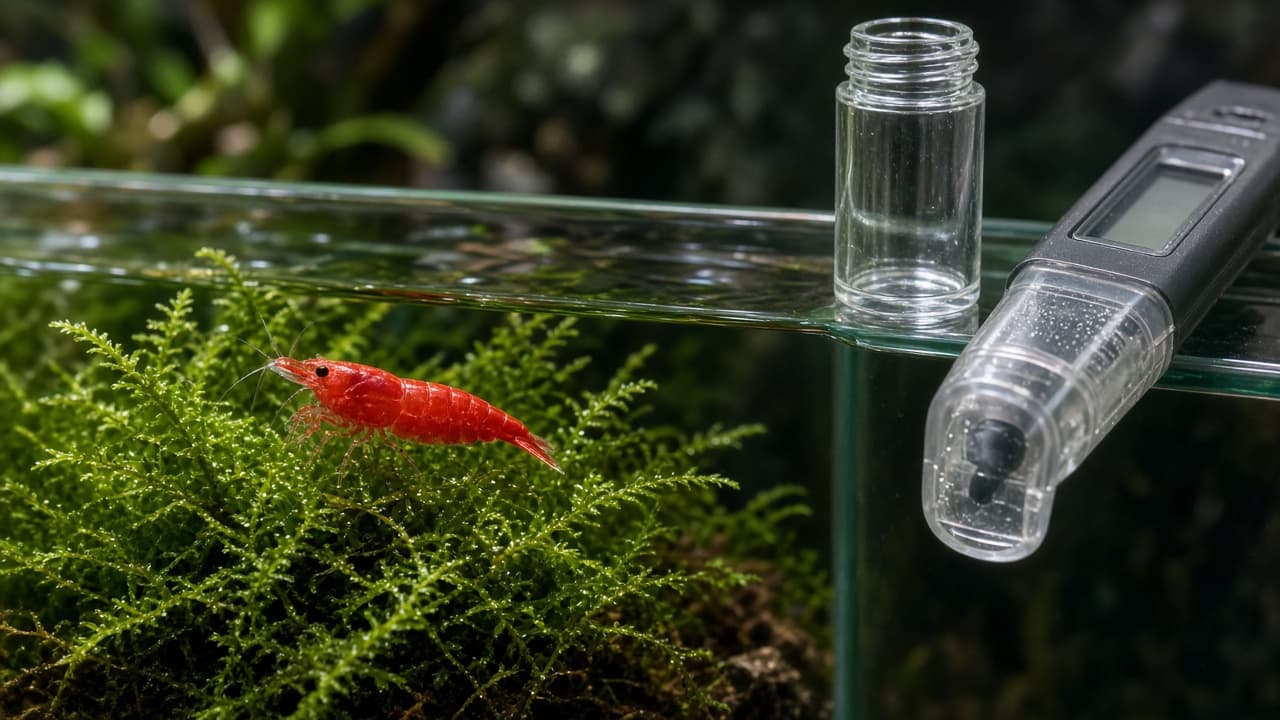
A drop test for pH, GH and KH is more reliable than most strips. A simple TDS meter also gives a quick check between fuller tests.
Test the same aquarium, at roughly the same time, and write the result down. Then you see the trend, not just a one-off number.
When should you test?
Test when the tank is new, after larger water changes, and if the shrimp suddenly behave differently. In a stable tank, once a week or every other week is often enough.
What happens when values jump?
Shrimp breathe and moult in the same water around the clock. If pH, GH or TDS changes quickly, the body is stressed. They may hide, stop eating or shed their shell at the wrong time.
Amano are hardier than most dwarf shrimp, but even they suffer from large swings. A Blue Diamond that has lived a long time in the same water can react badly to a sudden switch to very different tap water.
Common misunderstandings
• That RO water is always better, even without minerals
• That you must hit an exact pH every day
• That TDS tells you everything about water quality
• That a higher pH is automatically dangerous for Neocaridina
TDS tells you how much is dissolved, not whether the water is good. Two tanks can share the same TDS and still have a completely different composition.
A simple routine
Test your tap water once. Test the aquarium regularly. Change small amounts of water at a time. Adjust only if something is actually wrong, not because a chart online shows a different number.
Once you can read pH, GH, KH and TDS without feeling unsure, the rest of the care becomes calmer. The next step is to see how water changes and temperature connect to the same numbers.