When and how do you change water?
A water change should be a calm habit, not a big clean-up. When you do it the same way each time, the shrimp barely notice that anything happened.
This article is about the act itself: when you should do it, how much you take out, and how the new water is allowed in.
When should you change water?
In a typical beginner tank with Neocaridina, once a week is a good base. Pick a fixed day so it is not forgotten until the water is already heavy.
Also change if nitrate has risen clearly, if you accidentally overfed, or if the water smells stale. Do not skip the weekly change just because the tank looks clean.
How much should you change?
10–20 percent is about right in most tanks with Red Sakura, Bloody Mary or Yellow. If you have just started, or if the tap water differs a lot from the tank, stay closer to 10 percent.
Crystal Red and Blue Bolt often do best with even smaller, more frequent changes. The principle is the same: small steps, the same water every time.
Prepare the water
Pour the water into a clean bucket used only for the aquarium. Add dechlorinator. Let it reach the same temperature as the tank, or very close.
• Never use buckets that smell of washing-up liquid
• Measure the temperature in both bucket and aquarium
• Mix minerals now if you use RO water
• Stir so everything is even before you pour
Temperature and dripping
New water that is several degrees colder or warmer stresses the shrimp. It is one of the fastest ways to ruin an otherwise good change.
Pour slowly. In sensitive tanks you can drip. In a typical Neocaridina tank it is enough to pour against a stone, a leaf or the glass so the flow breaks.
A practical method
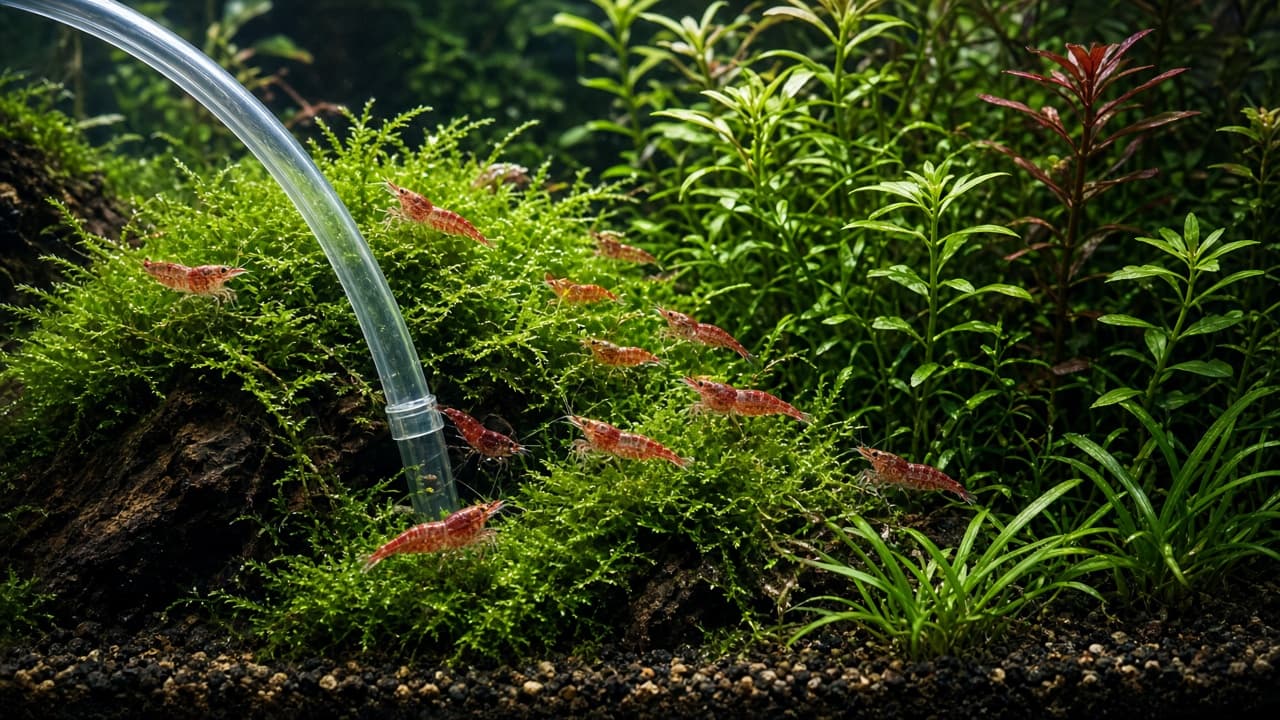
Switch off the heater if it could end up in air. Lower the hose. Take water from the bottom where debris collects, not only from the surface.
Then pour in the prepared water. Put the equipment back. Watch the shrimp for a moment. They should keep grazing as usual.
What not to siphon
Do not siphon away all the biofilm, all the moss or the entire substrate. Blue Diamond and Orange Sakura live off what sits on the surfaces.
Remove rotting leaves, leftover food and visible dirt. Leave the thin life on roots and glass.
Watch the shrimp
A hose can suck up a shrimp. Keep the end above the moss, or use a guard. Look for shrimplets before you start.
After the change
Do not feed extra as a reward. Give the tank time. If the shrimp hide for an hour it is often just the movement that disturbed them, not the water.
Do not clean the filter on the same day. One job at a time.
New tanks and mature tanks
In a young tank it is extra important that changes stay small. The bacteria are still sensitive. In a mature tank with Amano and a dense colony you can keep the same percentage, but be more careful about removing visible waste.
Common mistakes during the change
• Using water straight from the hot-water heater
• Changing a lot to make up for a forgotten week
• Wiping the glass and vacuuming the bottom on the same day the filter is washed
• Pouring new water as a torrent straight onto the shrimp
A weekly routine that lasts
The same day, the same amount, the same bucket, the same dechlorination. After a month it takes a quarter of an hour and the shrimp treat it like rain.
When the change sits in your hands, it also becomes easier to receive new shrimp. The next step is adding animals to a colony that already has its rhythm.